5. December 2025
What the EU Initiative Means for Businesses and Why AI Will Be Essential for Future E-Invoicing
The EU’s ViDA – VAT in the Digital Age initiative marks one of the most significant changes in European invoicing and tax reporting in decades. By 2030, all cross-border B2B transactions within the EU must be reported digitally, in structured form, and almost in real time. Traditional invoices—whether PDF or paper—will no longer meet regulatory requirements.
For companies, this shift represents a fundamental transformation. Manual workflows will give way to fully digital, AI-supported and automated purchase-to-pay and order-to-cash processes.
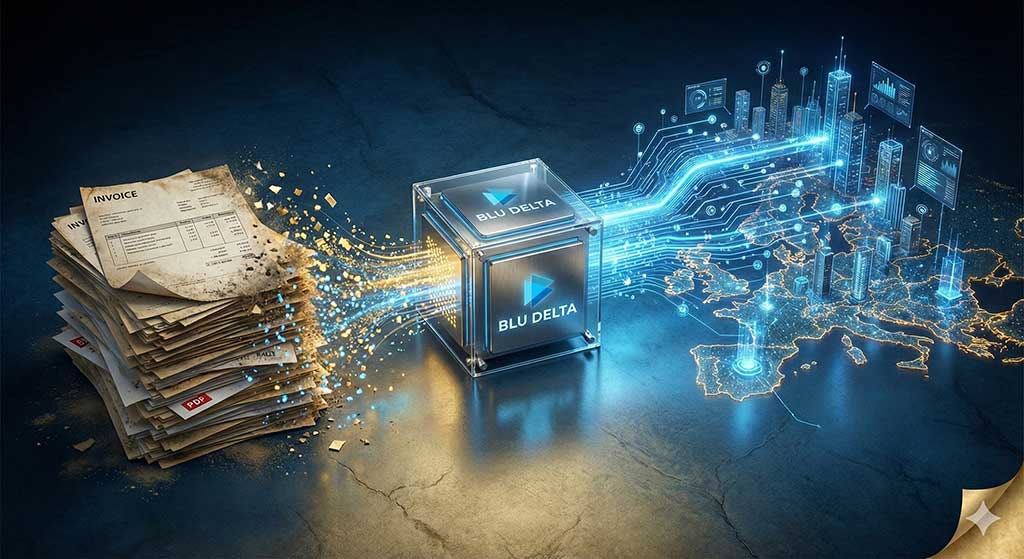
But what exactly is changing? And how can organisations move from today’s mixed, fragmented invoice landscape to a harmonised EU-wide system?
ViDA at a Glance: The Future of Europe’s Invoicing Landscape
ViDA has a clear mission: reduce VAT fraud, harmonise processes across the EU, and accelerate digital transformation among businesses. E-invoicing and digital reporting are the core pillars of this strategy.
Concretely, ViDA introduces:
ViDA is far more than a tax project. It is a digital transformation programme for Europe’s entire economy.
Why E-Invoicing Becomes Mandatory Now—Not Only in 2030
Many businesses believe ViDA starts in 2030, leaving them “plenty of time”. In reality, implementation has already begun.
Countries like Germany are phasing in e-invoicing requirements:
- 2025: mandatory ability to receive e-invoices
• 2027: mandatory issuance for larger companies
• 2028: mandatory issuance for all German B2B companies
Companies that want to be fully ViDA-ready by 2030 must start integrating e-invoicing into their processes now.
Why Traditional Invoice Processes Cannot Meet ViDA Requirements
Today, most organisations rely on a patchwork of:
• PDFs, scans and email attachments
• partially automated OCR-based workflows
• structured XML invoices
• manual checking and corrections
• inconsistent ERP processes
This complexity is incompatible with ViDA.
The new requirements demand:
• near-perfect data quality
• fully compliant EN 16931 structures
• automated error detection
• secure and scalable integrations
• stable and traceable end-to-end workflows
Manual steps become a risk in a system that processes data every second.
Why AI Is the Key Enabler for ViDA
Structured e-invoices are only the foundation. To operate in a ViDA-compliant environment, companies need systems that:
Modern AI succeeds because it combines rule-based validation with semantic understanding and experience learned from millions of documents.
How BLU DELTA Helps Companies Become ViDA-Ready
BLU DELTA is built for real-world complexity, not theory. The platform supports companies exactly where they are today: in the middle of transformation.
Key advantages include:
• automated processing of structured e-invoices such as XRechnung and ZUGFeRD
- EN 16931 validation with detailed error detection
- AI-supported interpretation of complex invoice logic
- bridging capabilities for PDFs in mixed environments
- ISO 27001-certified cloud or on-premise options
- APIs that enable ViDA-ready digital workflows
- scalability for high volumes and real-time needs
With BLU DELTA, companies establish a stable, automated workflow from invoice receipt to ERP booking—exactly what ViDA requires.
Next Steps: Achieve ViDA Readiness and Start Automating Today
If you want to assess your organisation’s readiness for ViDA or understand how AI-driven structured invoice reporting works in practice, we are here to support you.
BLU DELTA is a product for the automated capture of financial documents. Partners, but also finance departments, accounts payable accountants and tax advisors of our customers can use BLU DELTA to immediately relieve their employees of the time-consuming and mostly manual capture of documents by using BLU DELTA AI and Cloud.
BLU DELTA is an artificial intelligence from Blumatix Intelligence GmbH.

Author:Martin Loiperdinger is Co-Founder and CEO of Blumatix Intelligence GmbH. Previously, he was responsible for the development of copy protection solutions at an internationally operating corporation and later worked as an independent consultant for medium-sized companies and large enterprises. Since 2016, he has been driving AI-supported document processing, making Blumatix one of the most innovative providers in the DACH region. His goal is to enable seamless information exchange between companies.
Contact: m.loiperdinger@blumatix.at