12. December 2025
AI in Invoice Automation: How the Collaboration with Salzburg University of Applied Sciences Drives the Next Development Leap
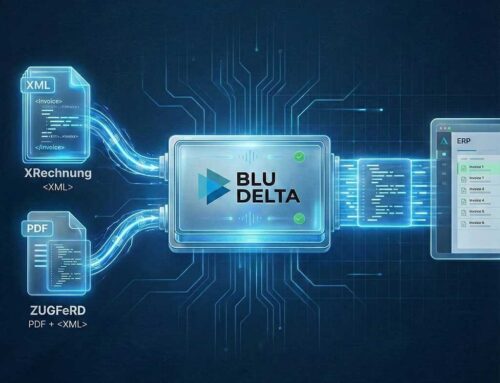
The digitalisation of financial operations is reaching a decisive stage. Structured e-invoicing formats such as XRechnung and ZUGFeRD are becoming the new standard. The EU’s ViDA initiative will introduce unified, near-real-time reporting across Europe. As a result, companies are under pressure to achieve higher levels of precision, automation and scalability in their invoice workflows.
At the same time, Large Language Models (LLMs) and modern AI methods are becoming increasingly powerful—yet also more complex to deploy reliably.
This is where the collaboration between Blumatix and Salzburg University of Applied Sciences comes in. Together, the teams are researching how AI-driven extraction, validation and self-learning can make invoice automation more accurate, stable and intelligent. The findings are clear: combining advanced AI models, structured data and controlled learning forms the next stage in AI invoice processing.
Why LLMs Need Reliability Mechanisms in AI Invoice Automation
LLMs can understand text, recognise structures and extract information at scale. But in accounts payable (AP) automation and document processing, raw model power is not enough. Reliability, consistency and explainability are essential.
Financial data requires strict accuracy. Totals, tax amounts and mandatory fields must always be correct. Errors directly affect accounting, compliance and reporting.
Blumatix Intelligence therefore addressed the central question:
How can LLMs be made reliable enough for business-critical invoice workflows—learning quickly, avoiding hallucinations and providing a measurable assessment of output quality?
The Reliability Score – A Scientific Method for Evaluating Model Output
Research at Salzburg University of Applied Sciences shows that the reliability of LLM-based extraction increases significantly when results are not evaluated in isolation. Instead, several model variants are compared and assessed using statistical methods. The outcome: confidence intervals that indicate how likely a given extracted value is to be correct.
Based on these probabilities, a threshold can be defined:
If the reliability score exceeds that threshold, documents can be processed automatically. If the score falls below it, the system forwards the case for manual validation. This significantly reduces manual effort for correctly structured documents while still ensuring human oversight for ambiguous or sensitive cases.
For invoice processing, this means:
- Stable extraction across diverse layouts
- Higher accuracy for amounts, totals and taxes
- Reduced error rates for highly variable fields
- Reliable output even for international formats
BLU DELTA already uses multimodal models and validation mechanisms. The findings from Salzburg complement this architecture with a precise, scientifically grounded method for assessing output quality—an important building block on the path toward robust, self-learning invoice workflows.
How RAG and Self-Learning Improve Contextual Accuracy in Invoice Processing
The second research focus addresses contextual understanding. An LLM can read what’s written on a document, but it does not inherently understand whether the content is meaningful or complete.
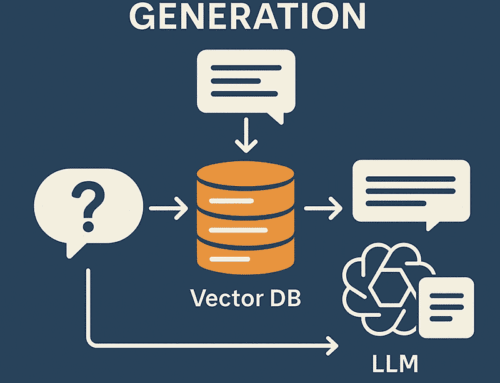
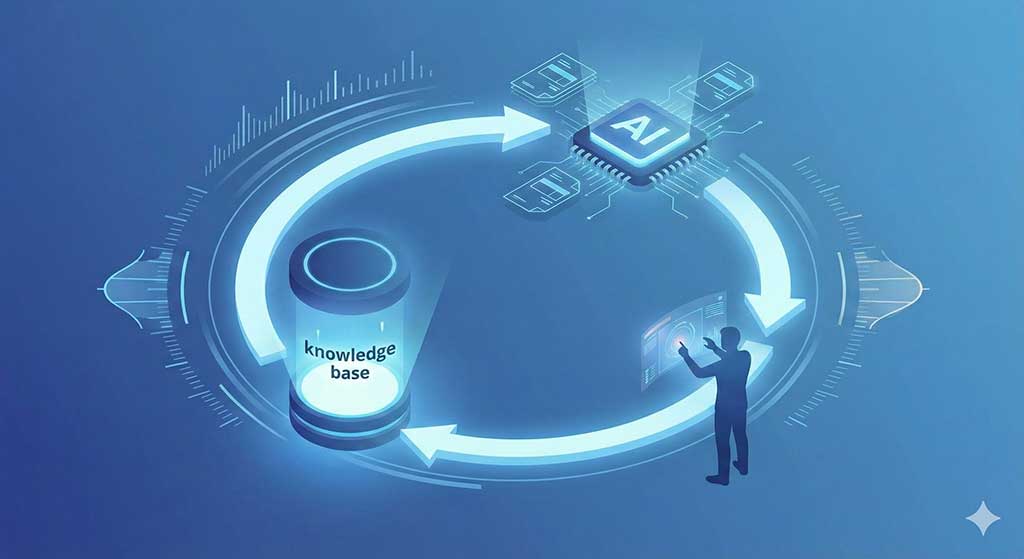
This is where Retrieval-Augmented Generation (RAG) comes in. A knowledge base supplements the model with relevant context—historical data, supplier profiles, tax rules or typical bookkeeping logic. As a result, the model becomes context-aware.
Combined with a human-in-the-loop approach, this creates a continuous self-learning cycle. The AI extracts data, the user corrects when necessary, and the system incorporates the correction into its knowledge base—leading to better decisions next time.
BLU DELTA is already ideally positioned for this. With the Learn API, RAG components and multimodal models, the platform is built to support continuous improvement. The results from Salzburg, which scientifically demonstrate BLU DELTA’s rapid learning capability, reinforce this direction.
Why this Research is Essential for Invoice Processes
Invoices are among the most complex document types: layouts vary widely, line items differ across industries, standards such as EN 16931 impose strict rules, and international formats add further complexity.
With ViDA, these requirements will increase even further. Real-time or near-real-time reporting demands near-perfect data quality.
The research conducted by Salzburg University of Applied Sciences provides insights that benefit not only the evolution of BLU DELTA, but also companies that rely on automated invoice workflows:
- More reliable extraction
- Robust output despite layout variability
- Lower error rates
- Cleaner validation
- Easier correction
- Less manual effort
- Higher scalability for large document volumes
Practice Meets Research – The Power of the FH Salzburg & Blumatix Partnership
Blumatix contributes experience from millions of processed documents and from building scalable, production-ready AI systems. Salzburg University of Applied Sciences adds methodological expertise in modern AI techniques. Together, they form a uniquely powerful combination—where research is not confined to the lab but flows directly into real-world production systems.
BLU DELTA benefits on multiple levels:
- Improved extraction quality
- Deeper validation
- Greater robustness for international invoices
- Enhanced learning mechanisms
- Future-readiness for e-invoicing and ViDA
For companies, this means a system that not only works today, but continuously improves over time.
Conclusion: The Future of Invoice Processing Is AI-Driven, Validated and Self-Learning
The collaboration with Salzburg University of Applied Sciences clearly shows where invoice automation is heading. Modern AI is becoming not just more powerful, but also more reliable. It combines extraction, validation, context awareness and continuous learning.
Blumatix is building precisely on this foundation—offering companies with BLU DELTA the technology they will depend on in the years ahead.
Bring Modern AI to Your Invoice Processing
If you want to explore how AI-driven extraction, validation and self-learning can improve your invoice processes, we’re happy to support you. You can schedule a consultation or test BLU DELTA in a free live demo.
BLU DELTA is a product for the automated capture of financial documents. Partners, but also finance departments, accounts payable accountants and tax advisors of our customers can use BLU DELTA to immediately relieve their employees of the time-consuming and mostly manual capture of documents by using BLU DELTA AI and Cloud.
BLU DELTA is an artificial intelligence from Blumatix Intelligence GmbH.

Author:Martin Loiperdinger is Co-Founder and CEO of Blumatix Intelligence GmbH. Previously, he was responsible for the development of copy protection solutions at an internationally operating corporation and later worked as an independent consultant for medium-sized companies and large enterprises. Since 2016, he has been driving AI-supported document processing, making Blumatix one of the most innovative providers in the DACH region. His goal is to enable seamless information exchange between companies.
Contact: m.loiperdinger@blumatix.at